GENEration Hope
Phelan-McDermidSHANK3Gene Therapy

Dr. Guoping Feng (MIT) on SHANK3 Gene Therapy, Brain Disorders, and What’s Coming Next

Dr. Guoping Feng

MIT neuroscientist and genetic medicine researcher

Welcome — I’m Ron Kleiman, and this is GENEration Hope. In this episode, I’m joined by Dr. Guoping Feng, Professor of Neuroscience at MIT, affiliated with the McGovern Institute, the Yang Tan Collective, and the Broad Institute.  We talk about: • Why he left medicine to pursue research that could lead to treatments for kids  • The urgency of moving faster — because “kids are growing up every day”  • Gene therapy delivery, the blood–brain barrier, and what’s changing with new vectors  • How AI and machine learning are speeding up vector design and behavioral testing  • The miniSHANK3 approach: why the full SHANK3 gene is too large, how a mini gene is designed, and how it’s delivered  • Where genome editing (base editing / prime editing) may fit in the future  If conversations like this help, please subscribe, like, and share — it’s the best way to support GENEration Hope.  This content is for informational purposes only and is not medical advice. Chapters 00:00 Cold open: the urgency + “that’s our hope”  01:07 Intro: state of genetic medicine (April 2026) + guest setup  04:29 Who Guoping is (MIT / Yang Tan Collective) + mission  04:54 Hangzhou med school → why he shifted to research  06:12 From fruit flies to mouse models (Drosophila → mammals)  06:40 PhD at SUNY Buffalo + moving into mouse genetics  07:20 Postdoc at WashU + “benefit patients” as the goal  07:52 Conditions his lab targets: PMS, Rett, SYNGAP1, Dravet  09:23 Can AI speed discovery? What actually moves things faster  10:15 Donors + centers at MIT + enabling translation to clinic  11:26 “Kids are growing up every day” + the role of young scientists  15:20 Why primate studies matter + safety confidence  16:25 Ben Deverman vectors + BBB is species-specific  17:39 ICV vs IV delivery + combining gene therapy with better capsids  20:14 AI protein design + ML behavior tracking + trial design  22:25 Lisa Yang’s story + SHANK3 connection  25:01 Why rare monogenic disorders need resources + “technical problem”  28:50 What a treatable world could look like for families  31:36 Brain plasticity + what changes might look like over time  32:46 Why foundations matter + speeding recruitment and development  36:20 Mini gene + safer genome editing (base editing)  40:30 Timeline: getting things into clinic (optimism + under 5 years)  41:53 Jaguar license: miniSHANK3 and why SHANK3 is too big  42:25 How they chose what to keep/remove in miniSHANK3  44:48 Why not split into two vectors? the delivery problem  46:33 Base editing limits + prime editing + Prime Medicine  48:54 Who owns IP at MIT/Broad + licensing basics  50:29 Explain it simply: what vectors are + how AAV9/ICV works  53:04 CSF basics + neuron counts + how much coverage is needed  55:26 Distribution challenges + future vectors + re-dosing & antibodies  58:13 Wrap-up + thanks + outro  #genetherapy #raredisease #neuroscience #autismresearch #phelanmcdermidsyndrome

Key topics

  • SHANK3 biology
  • brain disorders
  • gene therapy
  • clinical translation

Chapters

  1. 1. Cold open: the urgency + “that’s our hope”  01:07 Intro: state of genetic medicine (April 2026) + guest setup  04:29 Who Guoping is (MIT / Yang Tan Collective) + mission  04:54 Hangzhou med school → why he shifted to research  06:12 From fruit flies to mouse models (Drosophila → mammals)  06:40 PhD at SUNY Buffalo + moving into mouse genetics  07:20 Postdoc at WashU + “benefit patients” as the goal  07:52 Conditions his lab targets: PMS, Rett, SYNGAP1, Dravet  09:23 Can AI speed discovery? What actually moves things faster  10:15 Donors + centers at MIT + enabling translation to clinic  11:26 “Kids are growing up every day” + the role of young scientists  15:20 Why primate studies matter + safety confidence  16:25 Ben Deverman vectors + BBB is species-specific  17:39 ICV vs IV delivery + combining gene therapy with better capsids  20:14 AI protein design + ML behavior tracking + trial design  22:25 Lisa Yang’s story + SHANK3 connection  25:01 Why rare monogenic disorders need resources + “technical problem”  28:50 What a treatable world could look like for families  31:36 Brain plasticity + what changes might look like over time  32:46 Why foundations matter + speeding recruitment and development  36:20 Mini gene + safer genome editing (base editing)  40:30 Timeline: getting things into clinic (optimism + under 5 years)  41:53 Jaguar license: miniSHANK3 and why SHANK3 is too big  42:25 How they chose what to keep/remove in miniSHANK3  44:48 Why not split into two vectors? the delivery problem  46:33 Base editing limits + prime editing + Prime Medicine  48:54 Who owns IP at MIT/Broad + licensing basics  50:29 Explain it simply: what vectors are + how AAV9/ICV works  53:04 CSF basics + neuron counts + how much coverage is needed  55:26 Distribution challenges + future vectors + re-dosing & antibodies  58:13 Wrap-up + thanks + outro  #genetherapy #raredisease #neuroscience #autismresearch #phelanmcdermidsyndrome

Transcript

Transcript coming soon. This page is already connected to the published YouTube interview, and the edited transcript can be added here for search and accessibility.

Related explainers and articles

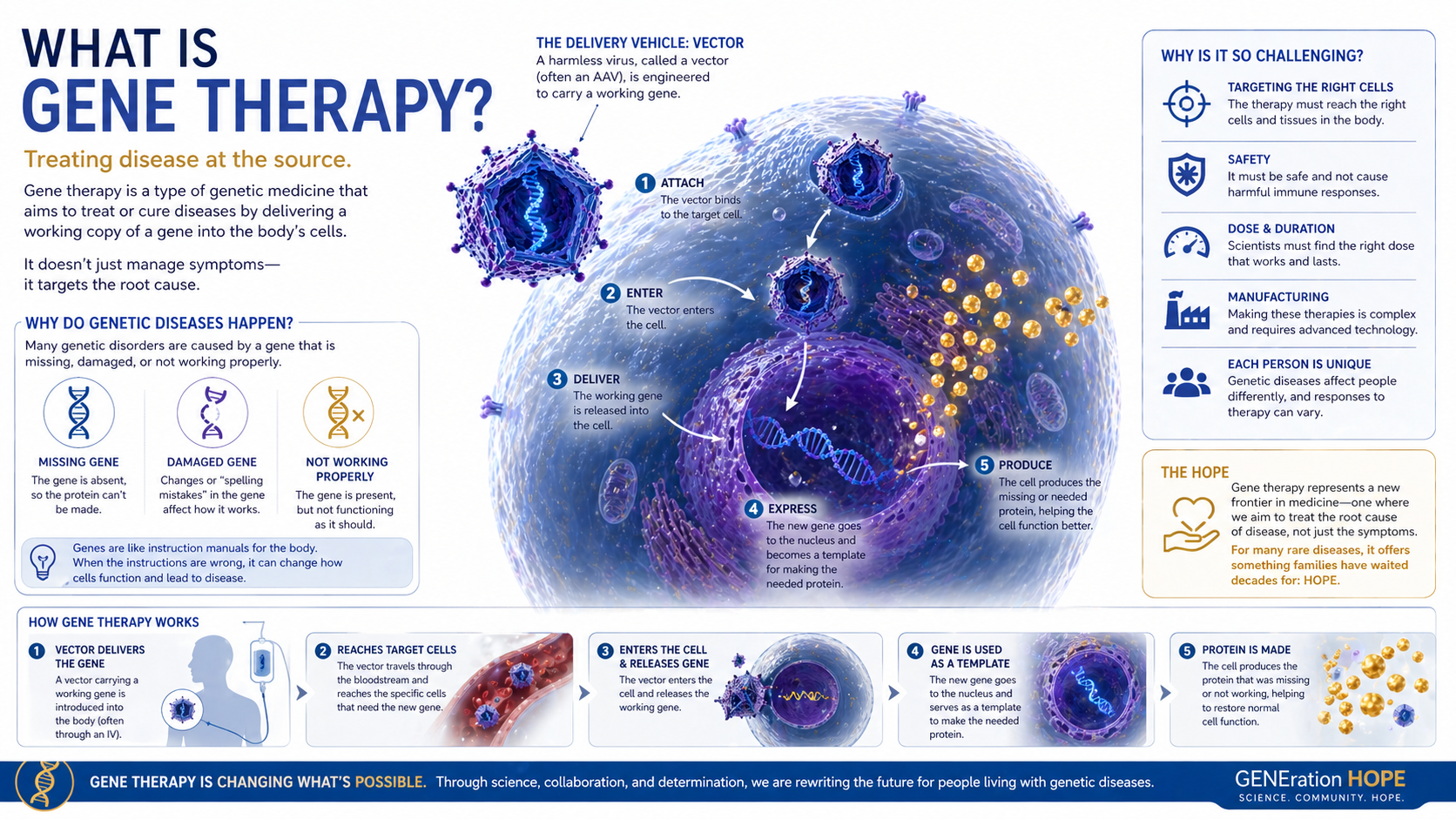
What Is Gene Therapy? explainer visual
Genetic Medicine

What Is Gene Therapy?

Gene therapy is a treatment approach that tries to address disease at the level of the gene, often by adding, replacing, silencing, or editing genetic instructions.
Gene TherapyAAVRare Disease
Watch / Read
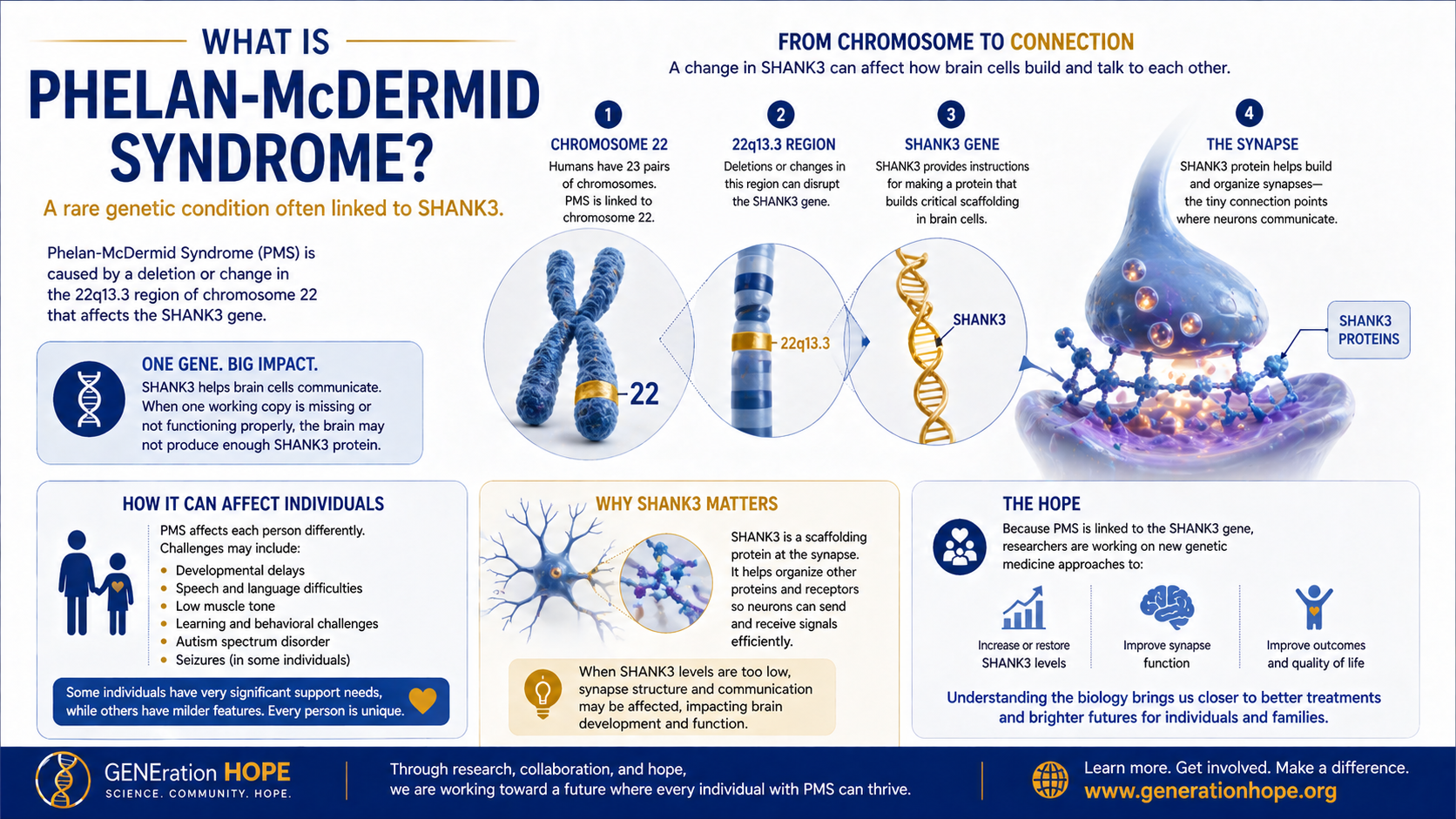
What Is Phelan-McDermid Syndrome? explainer visual
Rare Diseases

What Is Phelan-McDermid Syndrome?

Phelan-McDermid Syndrome is a rare genetic condition often linked to changes involving SHANK3 on chromosome 22.

SHANK3PMS
Watch / Read
AI + Rare Disease

What AI Drug Discovery Could Mean for Rare Disease Families

AI drug discovery is entering a new phase: not just better software, but a new industrial stack linking frontier models, pharma data, robotics, and real experiments.

Why it matters: Rare disease research often starts with small datasets, limited funding, urgent timelines, and difficult trial design. AI-linked discovery systems could help researchers generate stronger candidates and better experiments faster, but families should watch for clinical validation, access, manufacturing, and clear evidence rather than hype.

AI + Rare DiseaseAI Drug DiscoveryAutonomous Labs

Source: GENEration Hope editorial analysis

Read

Related interviews

How a Parent-Led Movement Grows: Sue Lomas (Phelan-McDermid Syndrome Foundation) thumbnail
Interview
Phelan-McDermidCommunityFoundation Building

How a Parent-Led Movement Grows: Sue Lomas (Phelan-McDermid Syndrome Foundation)

Sue Lomas

Sue Lomas helped build the Phelan-McDermid Syndrome community in the earliest days—when families were scattered, information was scarce, and finding “your people” took persistence. In this conversation, Sue and I talk about how rare-dise...

Watch Interview
Dr. Katy Phelan: The Origins of Phelan-McDermid Syndrome + Why Hope Is Growing thumbnail
Interview
Phelan-McDermidHistoryCommunity

Dr. Katy Phelan: The Origins of Phelan-McDermid Syndrome + Why Hope Is Growing

Dr. Katy Phelan

Welcome to GENEration Hope — I’m Ron Kleiman. Today’s guest is Dr. Katy Phelan, a pioneering human geneticist and one of the founders of the Phelan-McDermid Syndrome Foundation (PMSF). This conversation was recorded at the PMSF Annual Co...

Watch Interview